
How the rate schedule sets the charge
Each BC Hydro rate schedule defines billing demand its own way. Under RS 1830, BC Hydro's transmission service rate, billing demand is the highest of three values: the highest kVA demand during High Load Hours in the billing period, 75 percent of the highest billing demand in the preceding November to February, or 50 percent of the contract demand in the electricity supply agreement. For a new customer, billing demand in the first two billing periods is the average of the daily highest kVA demands. BC Hydro Electric Tariff, Rate Schedule 1830, effective April 1, 2026
Commercial accounts on other schedules follow different rules. BC Hydro's 2022 explainer says smart meters measure demand in 15-minute intervals, and the highest 15-minute average in each billing period is used to calculate the demand charge. BC Hydro: To reduce demand charges, know your load profile Rates and schedules change, so a project reads the current BC Hydro Electric Tariff for its own schedule.
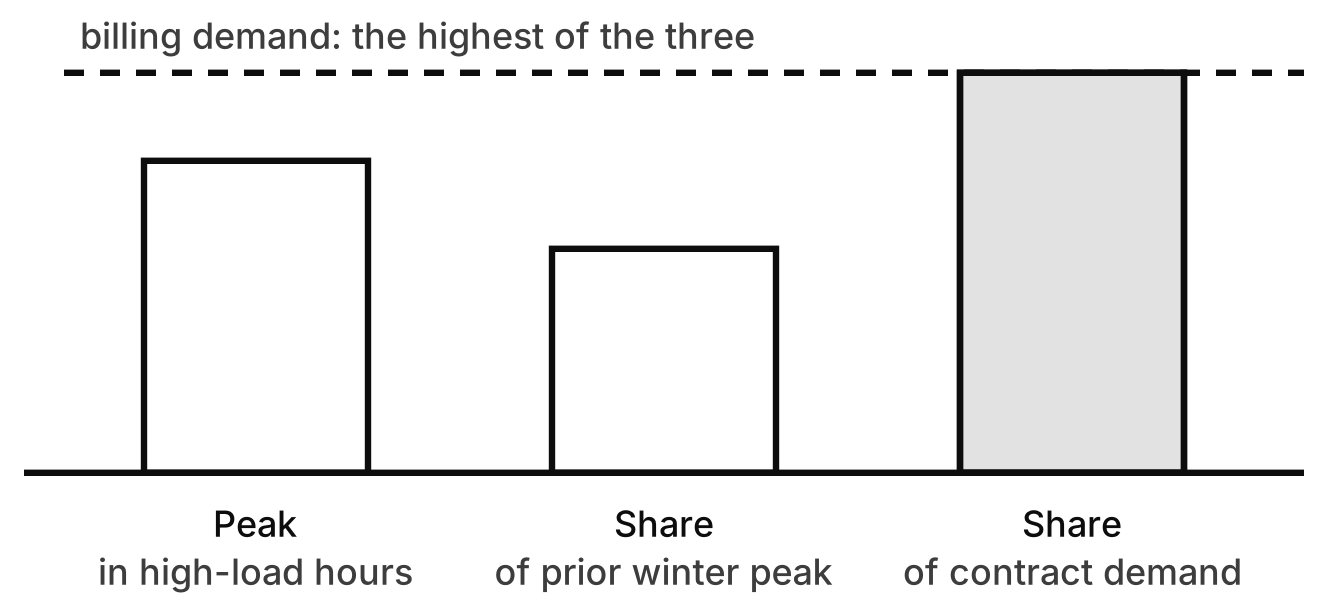
Operating peak and contracted capacity
Contract demand is the capacity stated in the electricity supply agreement. Under RS 1830, the billing floor at 50 percent of contract demand means a lower operating peak reduces billing demand only down to the floor and the winter ratchet. A battery that lowers operating peaks leaves the contracted connection capacity where it is. Changing contract demand is a matter between the site and the utility.
What limits a battery's effect
Five factors set how much a battery lowers a billing peak.

- Battery power: the most the battery can deliver in the peak interval.
- Usable energy: how much the battery can deliver across the length of the peak.
- Event duration: a peak that lasts longer than the energy lasts is only partly covered.
- Recharge timing: a battery that recharges from the grid in a counted interval adds to the draw.
- Site reserve: the energy the site holds back for its own use, which is not available to cut the peak.
A lower billing peak needs enough power for the peak interval, enough energy for its length, and charge in the battery when it starts. A battery with plenty of energy and low power covers only the power it can deliver.
How the battery is dispatched
Elastic sends the battery a dispatch for a set window. The Energy Router reads the power flows at the inverter, battery and gateway meters it connects to, so each dispatch can be read against what the rest of the site drew in that window. These are the site's equipment meters. The utility's meter sets the billing peak, so the utility's interval data is the final measure of any peak cut.
Each dispatch keeps a record of the command, the acknowledgement and the outcome. A project team lines the record up against the utility's interval data after the bill to see what the battery did in the counted intervals. How dispatch is validated covers the comparison.
Common questions.
What does the saving come to?
It depends on the schedule and the site's interval data, so the figure comes from the project's own bills and meter data.
Ask your assistant.
Explain this page from Elastic Energy in plain language: https://elasticenergy.com/cutting-peak-demand-at-a-compute-site